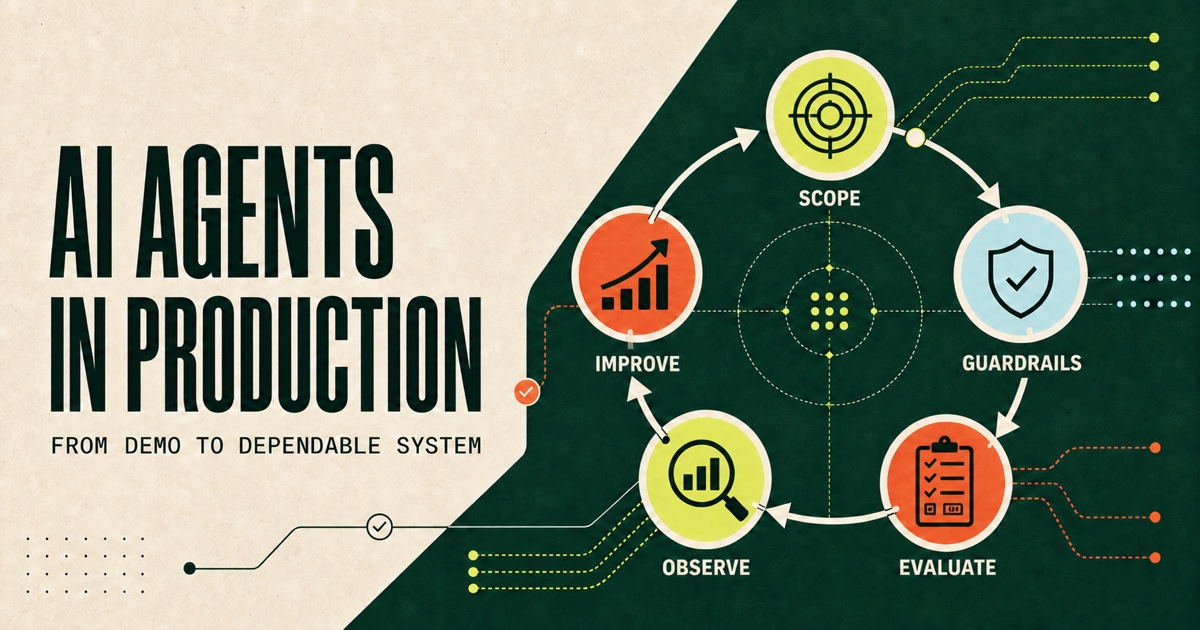
Why agent demos break in production
AI agents often look magical in a demo. Give one a goal, connect a few tools, and watch it plan and act.
Then real users arrive. Requests are ambiguous. APIs time out. Retrieved context is incomplete. The model takes an unexpected path, and a small mistake compounds across several steps. This is the central challenge of production agents: their flexibility is also their largest source of risk.
Adoption is moving faster than reliability
In LangChain's survey of 1,340 practitioners, 57.3% said they already had agents in production and another 30.4% were actively building toward it. Yet quality remained the biggest overall barrier at 32.9%, followed by latency at 20.1%.
Most teams observe agents. Fewer evaluate them.
The most striking gap is between seeing and knowing. Nearly 89% have observability, but only 52.4% run offline evaluations and 37.3% run online evaluations. Many teams can inspect a failure after it happens; far fewer can measure whether the next release is actually better.
What production-ready actually looks like
Reliability does not come from one perfect prompt or one evaluation score. It comes from a loop that connects product scope, system design, testing, production evidence, and iteration.
1. Start with a bounded job
Start with the simplest architecture that can solve the problem. A predictable workflow is often better when the steps are known; autonomy earns its place when the path genuinely requires judgment. Anthropic's guidance on effective agents makes the same case: complexity should improve outcomes, not merely make the system feel sophisticated.
2. Treat tools as product interfaces
Every tool should have one clear job, typed inputs, useful error messages, limited permissions, and an obvious stop condition. Read access should be separate from actions that send, delete, refund, or publish. The model should never receive more authority than the task requires.
3. Evaluate behavior, not just the final answer
For an agent, success is more than a fluent final response. Did it choose the right tool? Use the correct data? Recover from failure? Avoid unnecessary steps? Anthropic's agent-evaluation guide recommends combining graders because multi-step behavior cannot be captured by one score. A practical starting point is a small set of real scenarios, explicit success criteria, deterministic checks where possible, and human review for nuance.
4. Trace the real customer journey
Log the prompt version, retrieved context, tool calls, errors, latency, cost, and final outcome. Observability explains an incident; online evals show whether that incident is part of a pattern. Both are needed to separate a model problem from a retrieval, tool, orchestration, or UX problem.
5. Design failure to be safe and useful
Set retry and action limits. Ask for confirmation before consequential steps. Escalate when confidence is low or the task leaves scope. OpenAI's practical guide to agents recommends layered guardrails and human intervention for failure thresholds and high-risk actions. Then feed corrected production failures back into the offline evaluation set. That closes the loop.
The real advantage is the learning loop
Better models will help, but dependable agents will come from better systems around them. Define the job precisely. Give the agent the minimum tools and authority it needs. Measure both the outcome and the path. Watch what happens in production. Learn from every miss.