A large market, still early in adoption
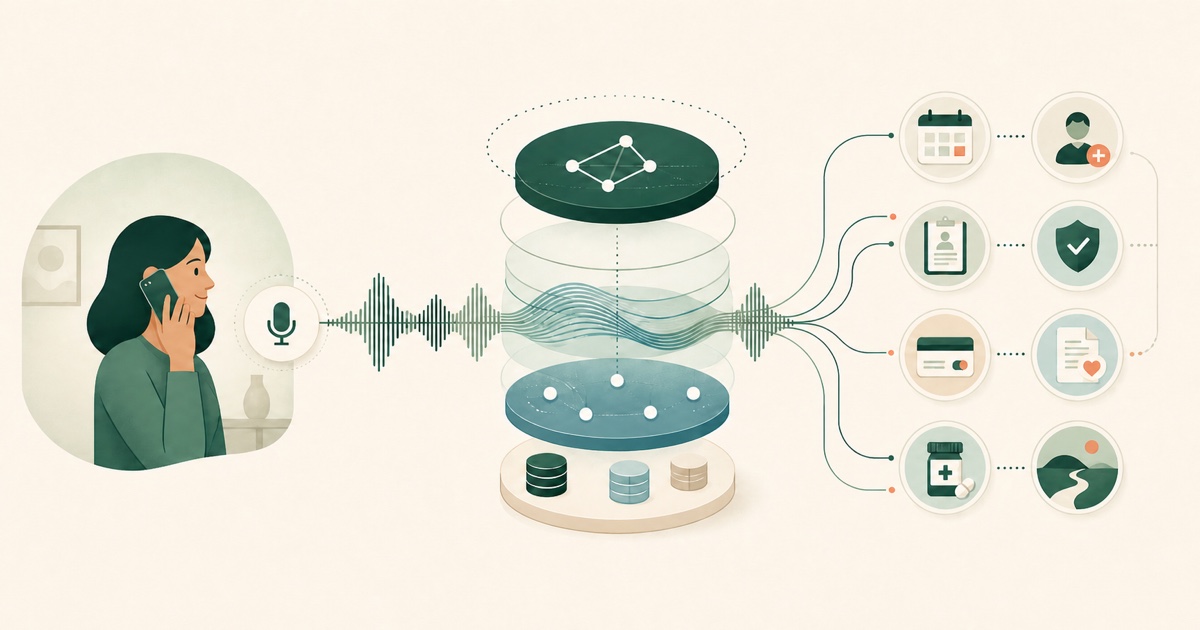
Voice AI is emerging as one of the most consequential applications of agentic AI. It is proving to be transformational across customer service operations, where voice agents can understand requests, work across business systems, and help resolve issues in real time.
The addressable market is significant. The United States alone has about 2.8 million customer service representatives, and PwC estimates the global contact center market at more than $350 billion. But the adoption remains early. McKinsey found that only around one in ten surveyed organizations had fully deployed these systems in customer care. The opportunity lies in closing the distance between a promising demo and a dependable service.
Industry opportunity: Healthcare
Few industries reveal the opportunity more clearly than healthcare. The United States spent $5.3 trillion on healthcare in 2024, with administrative activities estimated to consume 15% to 25% of total expenditure, or close to $1 trillion annually. A significant part of this administrative work includes millions of phone conversations about appointments, referrals, benefits, eligibility, billing, prior authorizations, prescriptions, and care navigation. Each interaction may require someone to collect information, interpret policies, and coordinate across disconnected systems, creating a significant opportunity for well-designed Voice AI.
The Voice AI Stack
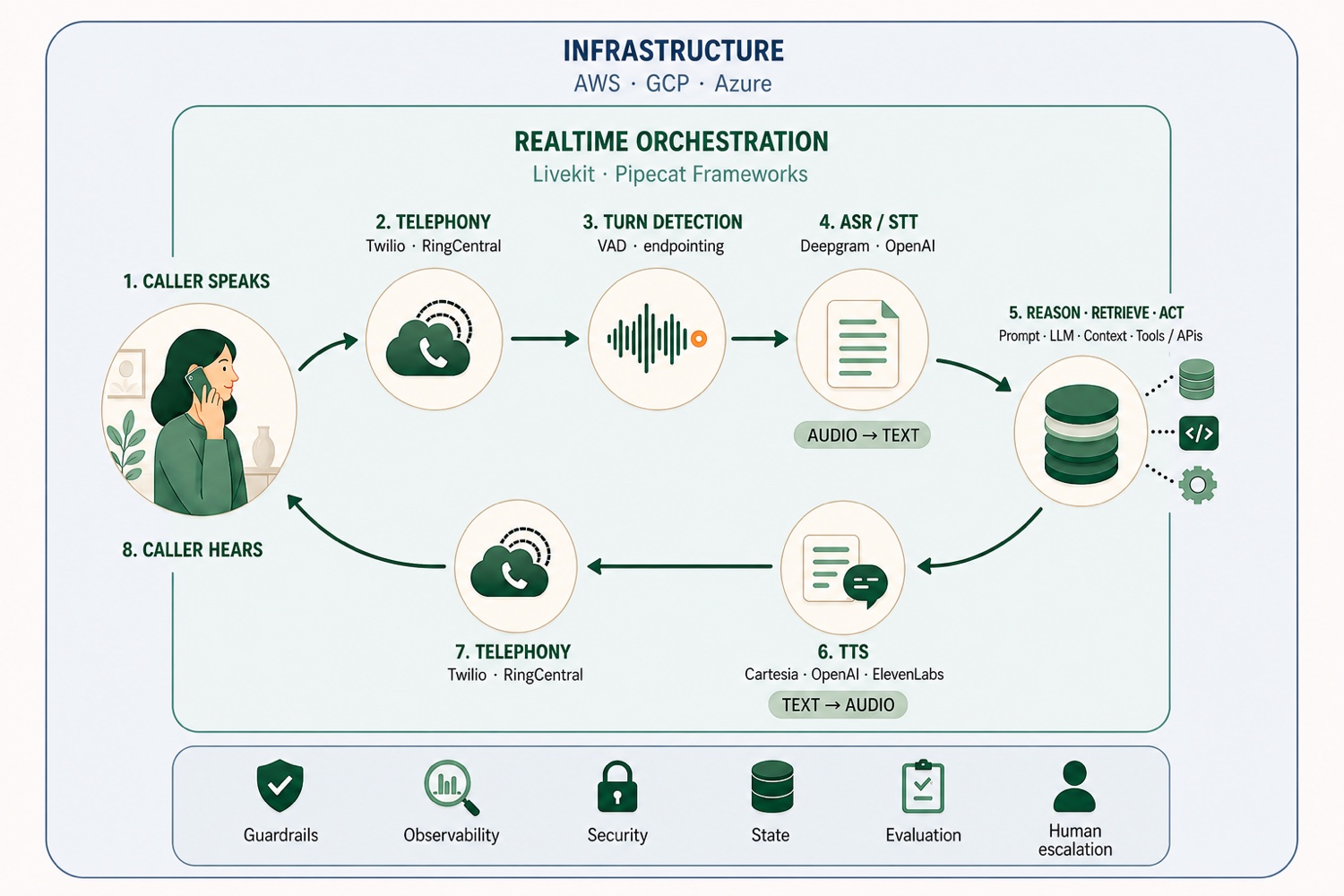
At its simplest, a voice agent converts speech to text, asks a language model what to do, and converts the response back to speech. This ASR → LLM → TTS pipeline explains the technology, but not the complete product.
 Open full-size diagram ↗
Illustrative provider examples. Realtime speech-to-speech models can combine the recognition, reasoning, and synthesis stages.
A natural voice connected to unreliable tools is still an unreliable product. The system must know who is calling, what it is allowed to do, how to confirm an important action, and when to bring in a person.
Why latency gets all the attention
On a website, a spinner tells people that something is happening. On a call, silence has no explanation. Even a short pause can make someone wonder whether the line dropped, the agent stopped listening, or they are expected to keep talking. That is why latency feels more disruptive in voice than it does on a screen.
Latency has five key components:
- 01
Voice Activity Detection (VAD): VAD detects speech and helps determine when the caller has finished. Short thresholds can cut off natural pauses, while longer ones make the agent slower to respond.
- 02
Speech recognition: Streaming ASR turns live audio into text. Phone quality, accents, background noise, and domain vocabulary affect both recognition speed and accuracy.
- 03
LLM reasoning and retrieval: The model interprets the request, uses conversation history, retrieves relevant context, and chooses the next action. More reasoning and retrieval steps add more delay.
- 04
Tool execution: Calls to CRMs, calendars, databases, and other APIs add network and processing time. Sequential calls, slow dependencies, and retries can quickly compound the delay.
- 05
Text-to-speech generation and delivery: The response is converted into audio and streamed through the phone connection. Time to first audio matters, but pronunciation, pacing, and buffering also shape perceived speed.
Teams often focus on time to first audio, or how quickly the agent starts talking. But users perceive the entire exchange. A quick reply is not useful if the agent cuts them off, repeats itself, or cannot finish the job.
What makes a conversation feel natural beyond latency
Speed is only one part of a good voice experience. A natural conversation also depends on how well the system understands different speakers, manages turns, carries context, adapts its delivery, and handles the imperfect audio conditions of a real phone call.
Understanding Accents & Dialects
Test recognition across the languages, dialects, speaking rates, and phone conditions of actual callers. Include names and industry vocabulary, and confirm critical details when confidence is low.
Interruption/Barge-in Handling
The agent should stop quickly when a caller corrects or redirects it. Adaptive interruption handling helps separate a real interruption from “uh-huh,” background speech, or other false triggers.
Context Switch / Retention
Callers revisit topics, correct details, and refer to earlier information indirectly. The agent should retain verified facts and completed actions across tools and handoffs, while treating the caller's latest instruction as authoritative.
Tone
Tone comes from both the words and their delivery. Voice, pacing, warmth, and directness should fit the task and caller's situation rather than making every conversation sound equally cheerful.
Background Noise Handling
Traffic, television, office chatter, and phone echo can hurt recognition and trigger false turns. Noise suppression helps, but testing should include realistic environments because aggressive filtering can also remove quiet speech.
Filler Messages
A specific message such as “I'm checking appointment availability” can explain a genuine delay. Generic fillers on every turn sound scripted, so they should be used sparingly and stop when the result arrives or the caller interrupts.
A product framework for Voice AI
A practical framework connects the customer problem, technical system, conversation, safeguards, and learning loop. It keeps product decisions from collapsing into a single latency target.
An easy way to remember it: use the VOICE mnemonic: Value, Orchestration, Interaction, Control, and Evaluation.
Evaluating the Voice AI agent
Voice AI needs a layered scorecard. No single metric explains whether an agent sounds natural, completes the customer's task, follows policy, and remains reliable under production load.
- Conversation Naturalness
- Response Quality
- Tone Adherence
- Talk Ratio
- Barge-in Handling
- Cutoff and Truncation Rate
- Intent detection accuracy
- Entity extraction accuracy
- Context retention accuracy
- Tool-call success rate
- Task completion rate
- Handoff success rate
- Policy compliance rate
- PII and PCI redaction recall
- Hallucination rate
- Required-confirmation adherence
- Escalation-policy adherence
- Unauthorized-action rate
- P50 and P95 end-to-end latency
- Time to first audio
- Concurrent-session capacity
- Error rate
- Availability
- Cost per resolved call
Containment alone is a misleading north star. A call can remain with the agent and still leave the customer unresolved. The better measure is successful resolution without avoidable effort or risk, segmented by intent, language, noise conditions, and customer journey.
The Key Takeaway:Fast is necessary. Outcome and Reliability is the goal.
Better models will make voice agents faster and more capable. The strongest products will also understand when to listen, when to act, how to recover, and what success means for the person on the call. Voice AI becomes valuable when the entire system earns the customer's trust, one completed conversation at a time.